
The only thing that matters after product / market fit.
Concept in brief.
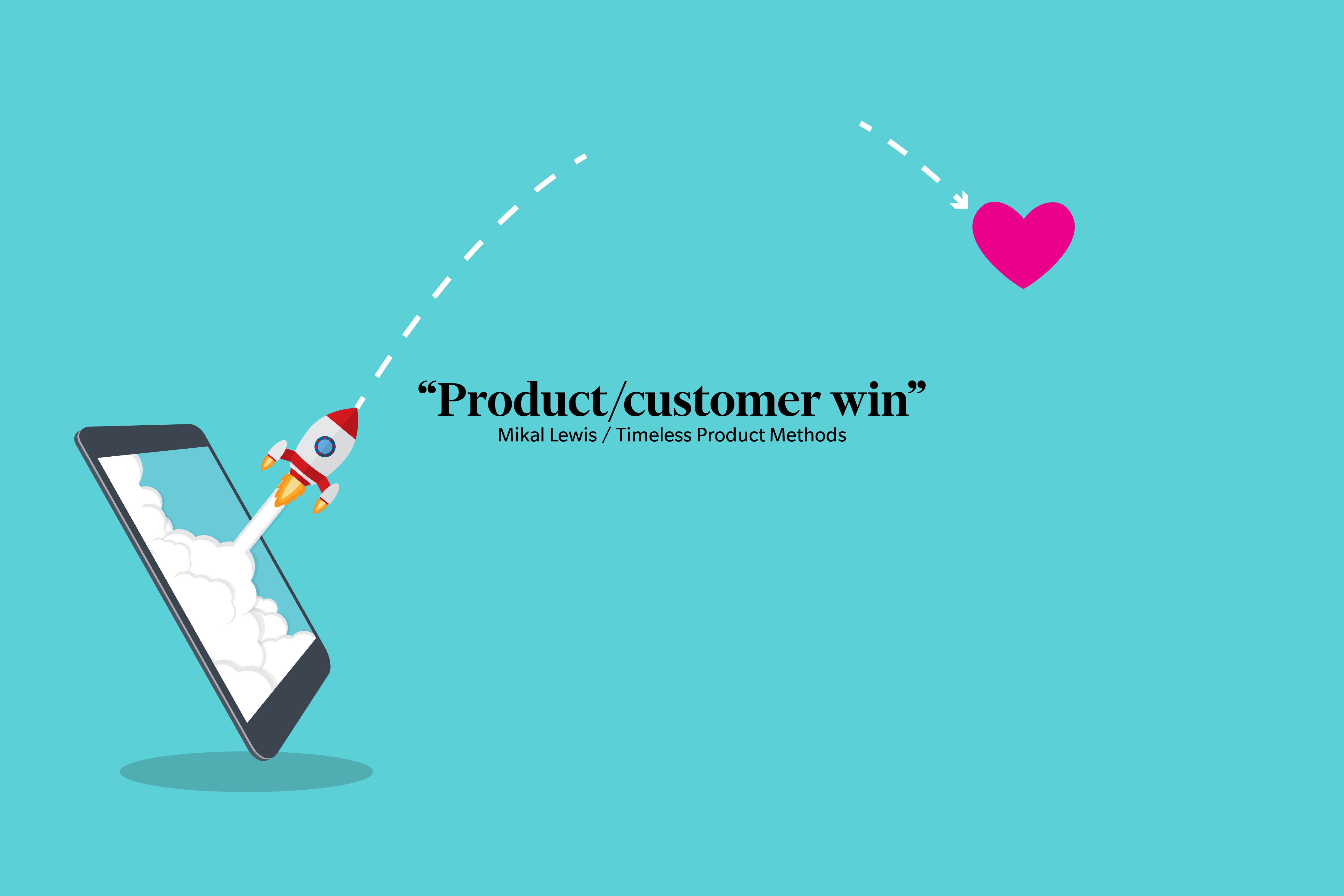
Once you have a revenue-generating product in an established market, most products have product/market fit. The critical question is, what’s next? Product/customer win. Product/customer win is fighting for your product as the preferred choice for your desired customer segment. It’s not about having the most users or the largest market share. It’s about being the preferred product for the customers that drive your business, as measured by qualitative measures. Once you’ve found a product/customer win—you need to defend and expand it by fighting for preference wins with new audiences. That’s the timeless way.
Key questions.
- Who is your target customer?
- What is your value prop—for winning these customers over as the preferred choice.
- Do you have qualitative tracking metrics in place to measure progress to this goal?
Concept in action.
- Research your market and identify your customer segment based on the customer characteristics and the jobs they have in your product category.
- Define your target customer segment based.
- Develop a product value prop that would win these customers.
- Measure based on qualitative measures, such as satisfaction scores in comparison to competitors for this audience, as well as quantitative measures, like the monthly customers in your target customer profile/behavior.
- Invest in product bets that will shift your product from a happenstance choice to one that always wins with that customer segment.
- Monitor progress. Align on a strategy that integrates your product, customers, and market so you can keep winning and growing for the long haul.
- After you win—identify a new customer segment to add to your product/customer wins.
Viewpoint.
Marc Andreesen’s essays on product/market fit made it clear. You need a good market and a product that fits it. That’s the focus of the Timeless Product Method. You work on both at the same time, following the same strategy.
But what comes next? I’ve worked on products at Microsoft, Nordstrom, and Mozilla that had product/market fit. The problem wasn’t the market or the fit. It was whether we were winning.
A big part of a product leader’s job is to define winning. Without thinking, teams will fall back on metrics like total users or market share. Meanwhile, Apple grew to become one of the world’s most valuable companies without being the biggest player in computers or smartphones.
In most markets, what matters isn’t market share; it’s the number of customers who take value-added actions. That’s how you measure success.
At Nordstrom, we wanted to win with fashion-forward customers. We measured a win every time a customer used our experiences 21 days out of 28. That’s a crazy high bar for an e-commerce site, but not for our audience. These customers lived and breathed fashion, making up a plurality of e-commerce revenue.
Most products unintentionally try to win the least engaged users by focusing on the wrong metrics. They never really compete to win by treating every customer like their largest, least engaged segment. They don’t grow with the customer or ask, “What would a product that provided the most value to our target audience look like?” “How frequently and in what scenarios does our hero customer use us?”
Asking that question led to some simple innovations that are now common in e-commerce. For example, you looked at a few products and selected a size to check availability. In that case, we’d remember that selection and show you availability without an extra click as you continue your session. Just like a good salesperson, these experiences won our audience over. For customers who made fashion a top priority, our experience became their preferred choice. We made the same investments with Firefox. For our audience, we needed to ensure the browser ‘felt’ personal because it was for our target audience with things as simple as pinning, easy defaults, and driving new privacy-protecting technology.
Each of these experiences was about something other than product/market fit, which we already had. By focusing on winning preference with our target audience, we were pursuing product/customer win. And that’s the job of any product: first, achieve product/market fit. Then, pursue product/customer win.
Product/Market Fit.
What’s the difference?
From ‘The only thing that matters’ essay:
In a great market—a market with lots of real potential customers—the market pulls product out of the startup.
The market needs to be fulfilled and the market will be fulfilled, by the first viable product that comes along.
The product doesn’t need to be great; it just has to basically work. And, the market doesn’t care how good the team is, as long as the team can produce that viable product.
In short, customers are knocking down your door to get the product; the main goal is to actually answer the phone and respond to all the emails from people who want to buy.
Marc Andreessen, The only thing that matters
That’s the story of search keyword advertising, internet auctions, and TCP/IP routers. It’s true in the high-growth phase of markets, which is what VCs and startup founders care about most.
But what happens after the product category is established and mature? These are the markets where most tech dollars flow. It’s here in this market phase that the product/customer win comes into play.
Product/Customer Win.
Product/customer win means competing to be the preferred product for use and purchase by valuable customer segments. I make the distinction between use and purchase primarily for enterprise markets. For example, Microsoft Teams had preference for purchase over Slack for a long time. It was free for many organizations. But it didn’t have a preference for use. End users preferred Slack. Teams didn’t take the lead until it focused on the Microsoft 365 customer. If you had Sharepoint and Exchange, Teams would become your preferred end-to-end messaging platform. Slack lost its lead in the purchase, which opened the door to losing its preference for use.
After product/market fit, the only thing that matters is getting to product/customer win, again and again.
You can always feel when product/customer win isn’t happening. Your customer base is random. They’re not really your customers, just customer coincidences. You close deals when you are cheaper than the competition. Or when the customer’s selection process is least rigorous. Or a customer has a gripe with the market leader that’s specific to their context and not scalable. You’re not winning these customers. You’re just in the right place at the right time, or your competitors are losing them. Your product doesn’t have higher satisfaction or hope of higher satisfaction with your target audience versus the competition.
That’s not what you want. That’s not product/customer win.
As a leader, you must have a clear customer segment with a specific goal or jobs-to-be-done. You know the sources of information they trust (not just friends and family), the other products they use, why they aren’t satisfied with your competitors—and how to reach them. You aim to develop a product value proposition and experience that wins this audience, defend your win against competitor moves, and expand your opportunity by finding adjacent customer segments and adding that product/customer win to your product scoreboard.
In the end, the pursuit of product/customer wins is a timeless endeavor. After product/market fit, it’s easy to get caught up in shipping features—timeless teams start to ask, “Towards what end?” Product/customer win is the answer.
Product/customer win is not a one-time achievement but a continuous focus on understanding, adapting, and discovering your evolving customers. By focusing on winning the hearts and minds of the customers you’re looking to ‘win,’ you build a product that becomes an integral part of their lives, a partner in their journey—and you transform your customer into an advocate because your product alone is the preferred choice. That is the essence of the timeless way—creating products that fit the market and win the love of the customers who matter most.
Leave a Reply