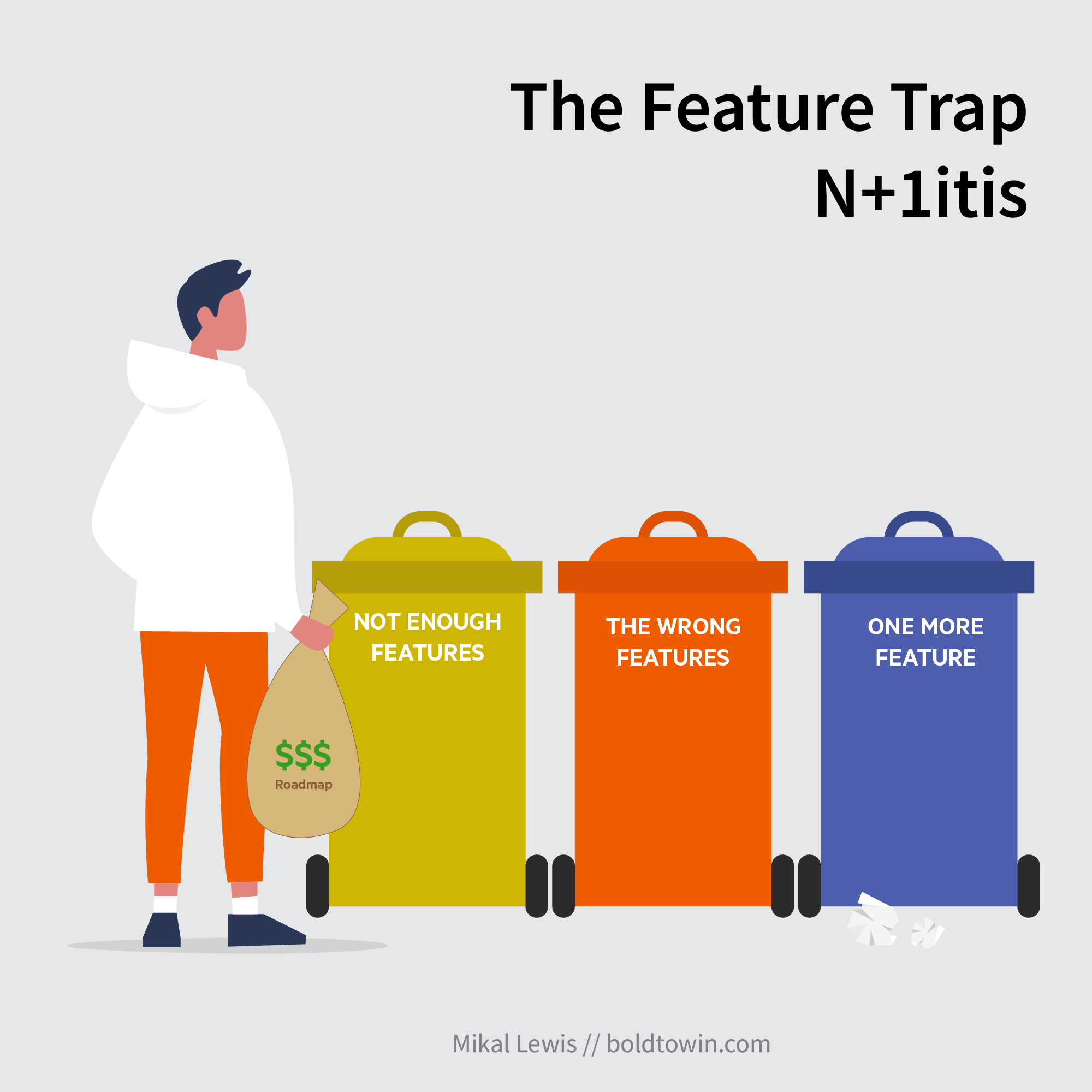

If your game plan for product success always requires a next feature, no matter how many features your product already has—you and your team may be suffering from N+1itis. What is N+1itis? It’s a malady where your current set of features, N, is never enough, but your team absolutely insists that the next feature, the N+1 feature, is the one that will cure your current ills.
When this happens, your next feature doesn’t just become an ingredient for success; it becomes the goal, and your team becomes a feature factory. You can tell when this happens. In planning, every team takes a critical dependency on the ‘next feature’, and they have no alternative plan without it. Unsurprisingly, the metrics don’t budge once that feature launches, and the goal posts move again. What the team really needs now is the N+1 feature.
I first became aware of N+1itis when Microsoft launched Windows Vista. It was an undeniably flawed product. When it launched, sales and marketing rightfully blamed the product, but also wrongfully threw up their hands: “We can’t sell this.” They had a list of features they required from the next version of Windows, which was due three years later, to unlock the sales pipeline. Steve Ballmer, CEO of Microsoft, challenged the culture—not selling your flagship product for three years is a fast way to go out of business. He said, “You sell the product you build, and you build the product you sell.” Even when you fumble the latter, the former still matters.
Microsoft performed a miraculous run of enterprise service agreements and sales during this era. What I realized during this moment in my career—when you blame the product, with all its shortcomings and what it doesn’t do—is that you never lean into selling the product as it is. Your team ends up in a trap where you never solve problems with what exists today—instead, you take a dependency on a hypothetical product of tomorrow. And since every product leader will tell you, you never have enough engineers, designers, or resources to deliver that product, you’re setting yourself up for a cycle of blame and disappointment.
Like tomorrow, the N+1 feature is always a day away, providing a perpetual solution and excuse for today’s less-than-stellar results. If this sounds like you and your teams, there is a solution: learn to win with one less feature before you build one more.
The N+1 Fallacy
When teams—whether Sales, Marketing, or Product—insist that the next feature is absolutely critical for success, they are effectively proclaiming that no product with the current set of features can succeed. But research has an answer to this assertion: you can always succeed with n-1.
In any competitive landscape, you’ll find a range of successful products—some with more features, others with fewer. There is a curve of features and capabilities, not at a single point.
In “The Innovator’s Dilemma,” Clay Christensen reveals why pattern: sustaining innovations add features (overfitting, a topic for a future viewpoint) while disruptive innovations subtract them (N-1):
Generally, disruptive technologies underperform established products in mainstream markets… products based on disruptive technologies are typically cheaper, simpler, smaller, and, frequently, more convenient to use.
The magic here isn’t from subtracting features; it is when you force your teams to understand which features matter.
The iPhone succeeded by redefining which features mattered, not by matching BlackBerry’s features. Netflix didn’t beat Blockbuster by adding physical stores—they won by removing them. Zoom didn’t beat Webex by having more capabilities. Each focused on subtracting something important to expand an existing feature. iPhone subtracted a keyboard to expand the screen; Netflix subtracted the physical store to expand the available catalog; Zoom subtracted IT complexity to expand video quality.
Bold to Win shift: You discover what is important when you shift from N+1 bloat towards N-1 focus.
If you had to win with one fewer feature than exists in your product today, what would you remove, and what would you focus on as you re-position your product? Until you understand this, you don’t fully understand your product or your path to future success.
This constraint-driven thinking produces better decisions and better products because you understand the why behind your product. You understand what problems must be and can only be solved by your product, and which problems are best solved through other means.
For example, teams often invest in in-product onboarding to drive successful product adoption. However, the secret ingredient to successful onboarding is in the customers who arrive there: What are their expectations and motivations?
Audience and customer acquisition should be solved first by examining who you target and what messages bring them in the door. Rather than a high-investment onboarding experience, you will have to constantly evolve with your product. And there is an added benefit: When you understand your customers’ motivations, you know which capabilities will move the needle.
How to Win with N-1
1. Identify “If I had to win without new features, what existing feature would I sell? And what feature would I remove?”
Force yourself to answer this question. What would you sacrifice to make something else exceptional?
2. How would you position that to your target customers?
What product positioning, or value proposition, excites your customers? It’s often simpler than you imagine. For example, at Nordstrom, the value proposition for e-commerce was “the most convenient way to bring home Nordstrom style.”
3. Focus your investments across the company on that advantage
Every feature needs to enhance this most essential win, or address an objection that gets in the way. Most product roadmaps are feature graveyards built for hypothetical users who don’t exist. In the Nordstrom example, “the most convenient way to bring home Nordstrom style.” Any significant investment that didn’t bridge the connection with Nordstrom, convenience, or style was getting in the way. Our target customer wasn’t some anonymous e-commerce customer; it was a customer who had already bought from Nordstrom.
4. Make Your Key Feature 10x Better
Instead of building five new features, what would it look like if this one feature were exceptional? Customers don’t tell stories about “all of the features”—they tell stories about the one that matters and how the rest of the capabilities support that experience. They don’t forgive broken core experiences.
For our team, Nordstrom looks like an industry-leading Dynamic Outfitting solution.
5. Leadership: Only Compare Plans Against Plans to Win. In roadmap discussions, inform the team that you need the plan to win with and without the next feature. Only entertain debate when you can compare the plan for success without new engineering investment versus the plan with investment. Engineering investment requires compounding maintenance costs, so only invest when it unlocks compounding benefit by opening a new market, increasing brand strength, or meaningfully lowering future cost to serve customers. Don’t fall for vague “new customers” or “brand benefits”—if it’s a bet on a new segment, teams should show where they’re making that bet across the organization. Products with meaningful revenue validate new bets with marketing and research first, not product development.
These solutions are easier said than done. As a leader, you must understand what gets in the way. Here are some common pitfalls.
Why Most Teams Resist N-1
Feature Velocity Feels Like Progress Shipping feels productive, even when it’s not strategic. Teams mistake motion for progress, confusing features with meaningful advancement toward customer value. You don’t want to stagnate, so progress is critical, but you need to know how teams plan to succeed with the product in market, not just betting on the next feature.
N+1 Absolves Responsibility for Past Results. When the current product isn’t missing the goal, blaming the missing “next feature” deflects accountability. It’s easier to point to what is missing than to acknowledge that existing capabilities might be poorly executed or solving the wrong problems. Every team and every product always has a missing feature to blame. If a team isn’t giving equal credit to existing features for success as they are to missing features for failure, be wary of the latter.
They Don’t Know How to Win. The focus on the next feature hides the fact that the team doesn’t know what caused success or what will unlock more. Every new feature competes for use and audience from existing features, first diluting focus rather than amplifying value. At Firefox, the mobile team initially misunderstood the market—the mobile market was different from the PC market, where everyone downloaded a third-party browser; on mobile, it was a distribution problem where few customers installed a second browser. Winning meant learning how to gain a distribution advantage. Our best bet was learning to convert the existing Firefox Desktop audience into Firefox Mobile audience—new features didn’t move the market.
The strongest product organizations understand and resist these pressures. They know that sustainable competitive advantage comes from doing the right things better, not more things, because there are always more things to do.
The Strategic Question
Before building your next feature, ask: “If I had to win with one fewer feature than exists in my product today, what would I remove, and what would I improve?”
This constraint forces you to identify what truly matters versus what’s nice-to-have. In markets where customers have infinite alternatives, the products that win aren’t the ones with the most features. They’re the ones customers genuinely cannot imagine living without.
And that level of customer dependency comes from exceptional depth, not extensive breadth. Break free from N+1itis by learning to win with less before you build more.
Leave a Reply