Managing Products in the Timeless Way
“There is a timeless way of building.”
—Christopher Alexander, A Timeless Way of Building
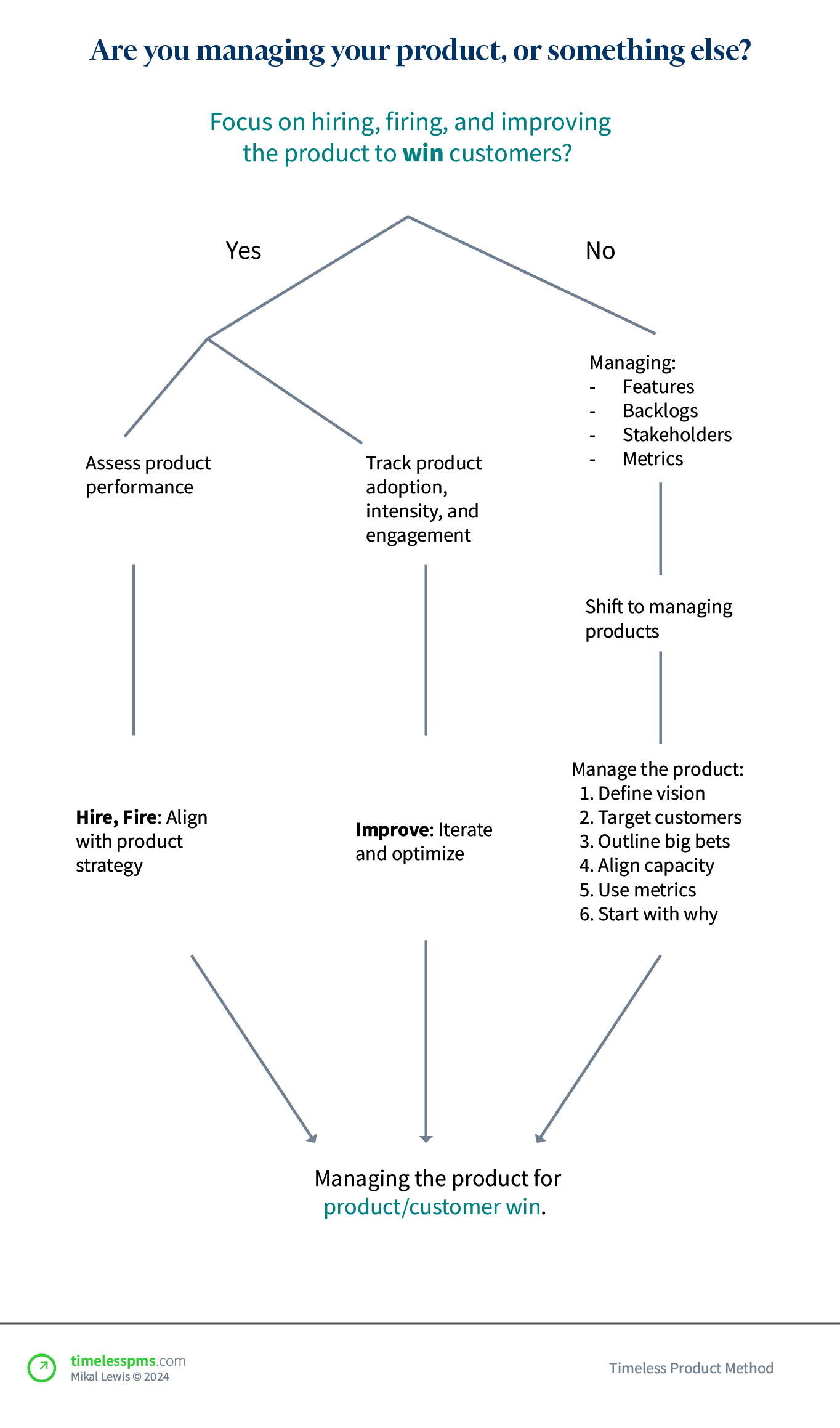
For product managers, there are two very different paths to choose from. One leads to delivering winning products that delight customers and drive tangible business impact. The other, despite being more common, leads to an unwinnable race on the busywork hamster wheel.
The paths diverge based on whether you are genuinely managing the product itself or managing something else entirely. While you might think you’re managing a product, more often, product managers find themselves managing:
- Backlogs—Shipping ‘tickets’—Prioritization decisions focus on ‘what you’re shipping’—tickets aren’t concentrated in any one area.
- Stakeholders—The Roadmap shifts based on the loudest stakeholder; when you say no to one request from a stakeholder, the implicit debt is that you say yes in the future.
- Metrics—You celebrate success based on the metrics you “can move,” mainly ignoring customer preference data when the metrics that matter and drive your business are largely outside your influence.
Managing the product
It’s far too easy for product managers to fall into the manage all-but-the-product trap. You start each cycle with “what” is in the backlog to build, “what” stakeholders have requested, and “what” got de-prioritized last quarter. The focus is aligning others, wrangling resources, and meeting aggressive deadlines based on optimistic estimates.

These things matter, to be clear, but when team discussions revolve around execution details, resolving dependencies, or finding the path of least organizational resistance, there is little room for substantive alignment about what it means to win customer preference relative to the competition.
Success metrics become self-referential – decreasing bug counts, increasing engineering velocity, burning down the backlog, and disconnected from any definition of winning that shows up in customers’ hearts, minds, or your company’s 10-K. Naturally, the product morphs, slowly at first, then all at once, into something the market doesn’t want.
When you manage the product, your primary role is hiring, firing, or improving product/customer win. You scrutinize each new feature idea through the lens of how it will tangibly enhance the product’s ability to win customers over. You’re looking at metrics and market pulse heartbeats—always looking to understand what is winning customers, what isn’t resonating with customers as much, and where you are losing customers. Your sources of customer DSAT have to be offset by more significant and hard-to-copy sources of customer love. This source can come from outside your product experience; it could come down to price—but you have to know, understand, and strengthen it.
You’re also always scouting for new talent – innovative features, streamlined workflows, or delightful design touches that could give your product an edge. You write good Job Descriptions—on what the product experience must do to work with the rest of the product, towards the product vision, and ultimately, product/customer win. When launching new features, it’s crucial to understand the typical adoption curve.
In typical cases, about 5% of your audience will try a new feature in the first month. Then, roughly 20% of that initial group will use it a second time in the following month, and so on. On average, it takes about three to seven uses for a new experience to truly take hold with users. (Update with your internal or category’s data, of course; the critical point is products and features gain customer adoption over time.) Remember this as you track early performance metrics and make iterative improvements. Don’t prematurely kill off promising new hires because they aren’t overnight successes, few are.
You regularly assess performance and fit with the overall product strategy for existing functionality. You provide targeted coaching and development for the product, emphasizing what’s working and cleaning up areas that inhibit customer preference while “managing out” those functions that no longer serve the product’s goals. When you’re managing the product, you start features at the lowest appropriate level of exposure possible, promoting rising stars as customers demand them through engaged use or their correlation with business impact.
As you monitor feature performance, pay special attention to those that become core to your product’s positioning and value proposition in the market. Track how you stack up against competitors on the key dimensions your target customers care about most. Are you winning significant customer preference in the market? Is your product consistently seen as the best solution for specific high-value needs? Any aspect of the product experience that moves the needle is a good source for doubling down. Keep doubling down on what’s working.
A different job entirely
On a day-to-day basis, when you manage the product, it means a different job entirely. This means you’re spending less effort in backlog grooming; backlog grooming becomes an engineering exercise for delivering against a product experience you all understand and have scoped. You spend more time engaging with customers directly through collaboration with marketing and user research and through data to understand their needs, preferences, and frustrations deeply. You’re poring over qualitative feedback and quantitative product metrics, looking for patterns and insights to guide your product hiring, firing, and improvement decisions. You’re managing your product to one hard-fought goal.

In short, you’re managing the product like an entity that needs constant tending and tough managerial decisions to reach its full potential. You’re not just going through the motions of managing features and managing stakeholders – you are doing your job—building a product to win customers in a competitive marketplace.
Making the shift from managing stuff to managing products
For product leaders stuck in “managing all but the product,” shifting to timeless product management requires some pivotal first steps.
For product leaders:
- Define the vision—Where is your product’s market headed? How can your product evolve to lead and win in that future state based on its differentiated capabilities and strengths? This should be a concise narrative arc covering the hypothesis about the future world your product will live in.
- Form your customer segment—Who are the specific user segments to obsess over, and what outcomes do they prize most in your product space? These aren’t personas; they are about characteristics such as what they want to accomplish and why—not about their personality or visualizing the customer. Don’t stop until you have an understanding of their acute problem.’
For PMs and Product Leaders
- Outline the big bets—Determine the big product experience investments (a maximum of two to three) in your area that will allow you to meaningfully win customers vs. competitors. Align goals around “winning” the number of highly valued customers (for example, customers who use this product three times a month), not just shipping.
- Align capacity—At least 50% of the team’s capacity and roadmap needs to go to these big bets and game-changing capabilities. Purge nice-to-haves and pet requests. Note that a big bet could be a technology re-platform.
- Use metrics as your performance report—Build accountability around objective customer-centric metrics like growing core customers or changes in reasons why customers prefer your product. Score how well the bets performed on two elements: Delivery, did you deliver the bets? Monthly (after delivery): How well is this bet paying off in driving customer preference? It takes at least six months to present a full report card.
Note: the full impact of new features and experiences often isn’t felt until several months after launch, given typical adoption curves. So don’t just assess success based on initial uptake – track ongoing engagement and preference metrics over time. The bar for success is even higher for elements that become core to your product positioning. They must consistently outperform alternatives and drive measurable improvements in how target customers view your product relative to competitors. Ruthlessly cut bait on anything that isn’t pulling its weight in delivering a winning product experience. - Start with why—Overcommunicate and align support for the product strategy across stakeholders and the broader business. Reaffirm that the goal is to win customers, and that’s where almost all capacity will go. Outline your hypothesis and why.
The path may seem more challenging than managing the seemingly concrete inputs of backlogs, stakeholders, and velocity metrics. But in today’s hyper-competitive markets, it’s the only way to achieve marketplace leadership and success. Anything else is just a different form of delivery management.
Managing products, is the timeless way.
Leave a Reply